

🧭 Mercury Compass #02
The Future-Ready School Framework 2030
Chapter 2: The Six Pillars of a Future-Ready School
A blueprint for building schools that prepare students not just for examinations—but for life, work, and leadership in 2030 and beyond.
Published by: Rapid Future Technology (RF Tech)
Series: Mercury Compass – Charting the Future of Education
Reading Time: 8–10 Minutes
Introduction
In Mercury Compass #01, we explored why schools can no longer prepare students for yesterday’s world. Artificial Intelligence, automation, sustainability, changing careers, and evolving societal expectations are fundamentally reshaping education.
However, understanding why transformation is necessary is only the beginning.
The next question every school leader must ask is:
What actually makes a school future-ready?
Many institutions immediately think about robotics labs, coding classrooms, AI software, or digital boards. While these investments certainly have value, technology alone does not transform a school.
A truly future-ready school is built upon a strategic foundation where leadership, learning culture, teaching practices, student development, and continuous innovation work together toward a common vision.
The schools that will lead the next decade are not necessarily those with the biggest budgets.
They will be the schools with the clearest vision.
This chapter introduces the Six Pillars of a Future-Ready School—a practical framework that school leaders can use to evaluate, strengthen, and future-proof their institutions.
Why Pillars Matter
Great schools are never built through isolated initiatives.
Installing a robotics lab without redesigning classroom experiences produces limited impact.
Introducing Artificial Intelligence without teacher readiness creates resistance.
Adding new technology without leadership vision often results in expensive equipment being underutilized.
Sustainable transformation happens only when every part of the institution evolves together.
These six pillars form an interconnected ecosystem where each pillar strengthens the others.
Pillar 1
Visionary Leadership
Every successful transformation begins with leadership.
Future-ready leaders don’t simply manage daily operations—they shape long-term direction.
They ask questions such as:
- What kind of graduates should our school produce by 2030?
- Which future competencies matter most?
- How should learning evolve over the next decade?
- How can innovation become part of our culture?
Visionary leadership creates clarity, inspires educators, builds trust, and encourages innovation throughout the institution.
Without strategic leadership, transformation becomes a collection of disconnected projects rather than a sustainable journey.
Characteristics of Visionary School Leaders
- Long-term strategic thinking
- Student-first decision making
- Innovation mindset
- Collaborative leadership
- Data-informed planning
- Continuous improvement culture
Pillar 2
Future Learning Ecosystems
Learning should not be limited to classrooms.
Future-ready schools create ecosystems where students experience knowledge rather than simply receive information.
These ecosystems encourage:
- Project-Based Learning
- Inquiry-Based Learning
- Design Thinking
- STEAM Integration
- Real-world problem solving
- Interdisciplinary learning
- Maker culture
- Experiential education
Instead of asking students to memorize answers, future-ready schools encourage them to investigate questions, experiment with ideas, and build solutions.
Technology becomes an enabler—not the objective.
Learning becomes active rather than passive.
Pillar 3
Empowered Teachers
No educational transformation succeeds without empowered teachers.
Teachers remain the most influential factor in student success.
The role of teachers is evolving from knowledge providers to facilitators, mentors, coaches, designers of learning experiences, and lifelong learners themselves.
Future-ready schools invest in:
- Continuous professional development
- AI readiness
- Digital pedagogy
- Leadership opportunities
- Collaborative planning
- Teacher wellbeing
- Innovation culture
When teachers feel trusted, supported, and equipped with modern instructional practices, students naturally benefit.
The future of education depends as much on teacher growth as student growth.
Pillar 4
Future-Ready Student Competencies
Academic excellence remains important.
However, tomorrow’s graduates will require far more than subject knowledge.
Employers, universities, and society increasingly value transferable competencies that help learners adapt to changing environments.
Schools should intentionally nurture:
- Critical Thinking
- Creative Thinking
- Collaboration
- Communication
- Digital Literacy
- AI Literacy
- Design Thinking
- Computational Thinking
- Leadership
- Emotional Intelligence
- Sustainability Awareness
- Entrepreneurial Mindset
These competencies should not exist as separate subjects.
They should be embedded across classroom learning, projects, extracurricular activities, assessments, and everyday school culture.
Pillar 5
Community and Industry Partnerships
Schools do not prepare students in isolation.
Strong partnerships expose learners to real-world challenges and emerging opportunities.
Future-ready schools actively collaborate with:
- Parents
- Alumni
- Universities
- Industries
- Startups
- NGOs
- Government organizations
- Technology partners
Such collaborations provide:
- Career awareness
- Mentorship
- Expert interactions
- Industry projects
- Internship opportunities
- Community engagement
- Innovation exposure
When education connects with society, learning becomes more meaningful and relevant.
Pillar 6
Continuous Innovation
Transformation is never a one-time project.
Education evolves continuously.
Future-ready schools establish systems that encourage experimentation, reflection, and improvement every year.
Innovation involves more than adopting new technologies.
It includes improving:
- Teaching practices
- Assessment methods
- Student wellbeing
- Administrative processes
- Parent engagement
- Campus sustainability
- Learning environments
Schools that regularly evaluate their practices are far more resilient than those that rely solely on past success.
Continuous innovation ensures that institutions remain relevant regardless of how education changes.
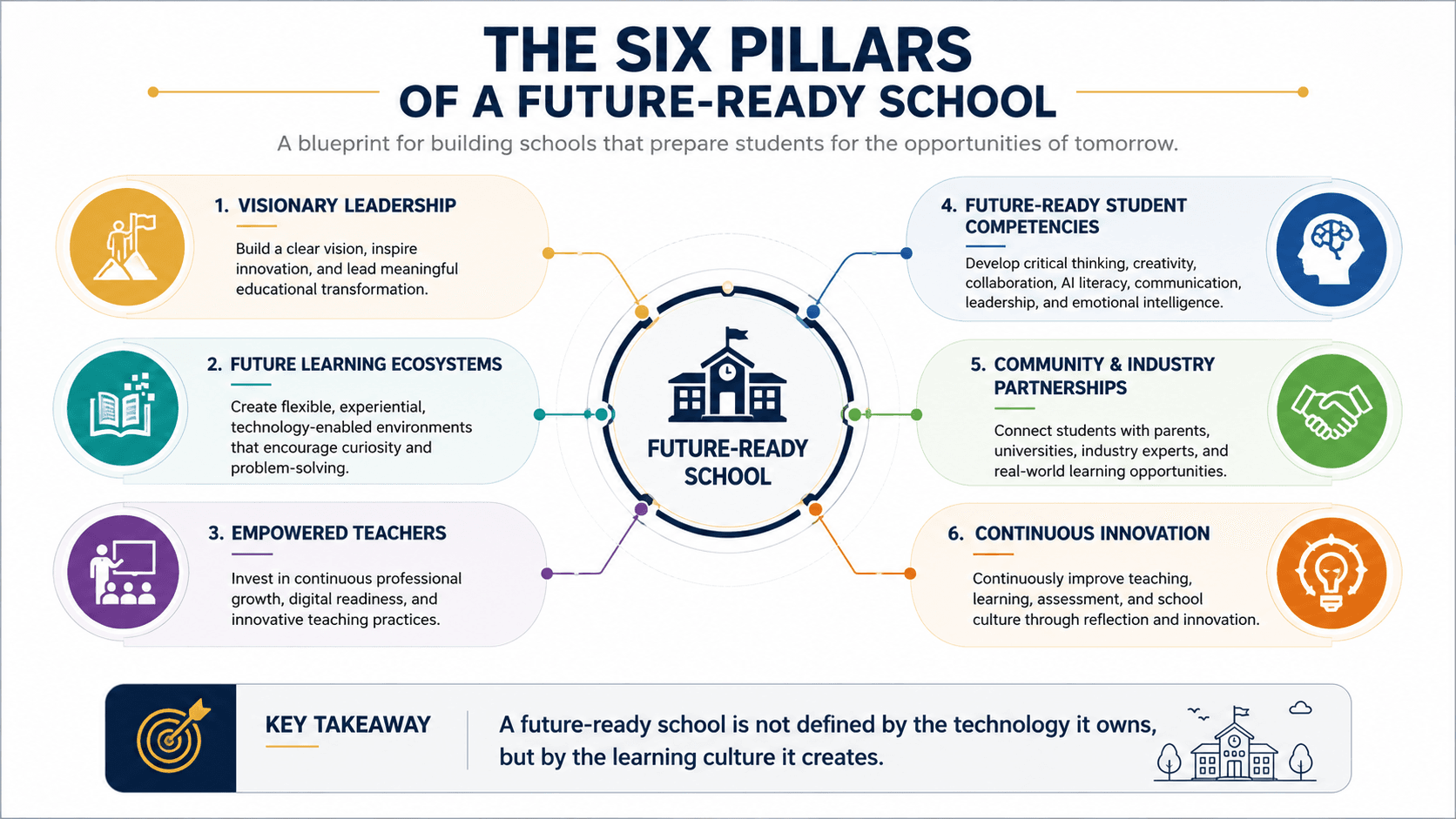
The Six Pillars of a Future-Ready School at a Glance
| Pillar | Primary Focus |
|---|---|
| Visionary Leadership | Strategic direction and culture |
| Future Learning Ecosystems | Modern, experiential learning environments |
| Empowered Teachers | Professional growth and instructional excellence |
| Future-Ready Student Competencies | Skills required for the next decade |
| Community & Industry Partnerships | Real-world learning and collaboration |
| Continuous Innovation | Ongoing institutional improvement |
A Self-Reflection for School Leaders
Before investing in the next technology initiative, consider these questions:
- Does our school have a clearly defined vision for 2030?
- Are future skills intentionally integrated into learning?
- Do our teachers receive continuous professional development?
- Are students solving authentic, real-world problems?
- How strong are our partnerships beyond the school campus?
- Do we regularly evaluate and improve our educational practices?
The answers to these questions often reveal where meaningful transformation should begin.
Looking Ahead
the six pillars of a Future-ready school are not created overnight.
They evolve through purposeful leadership, empowered educators, meaningful learning experiences, and a commitment to continuous improvement.
Technology will continue to change.
Careers will continue to evolve.
Artificial Intelligence will reshape industries.
But schools that invest in these six pillars will be better positioned to prepare students for an uncertain yet opportunity-rich future.
Transformation is no longer about keeping pace.
It is about leading the future of education.
Coming Next Week
Mercury Compass #03
Beyond Smart Classrooms: Building Complete Learning Ecosystems
Many schools have invested in technology, yet meaningful transformation remains elusive.
In the next edition, we’ll explore why learning ecosystems—not isolated technologies—are the true foundation of future-ready education, and how schools can create environments where innovation, collaboration, creativity, and lifelong learning thrive.
About Mercury Compass
Mercury Compass is Rapid Future Technology’s weekly thought leadership series created for Principals, Correspondents, Trustees, Academic Leaders, and Educators. Each edition explores emerging trends, research-backed insights, and practical strategies to help schools navigate the future of education with confidence.
About Rapid Future Technology
Rapid Future Technology (RF Tech) partners with schools to build future-ready learning ecosystems through STEAM education, Robotics, Artificial Intelligence, Astronomy, Experiential Learning, Teacher Capacity Building, and Educational Innovation. Our mission is to empower schools with solutions that inspire curiosity, creativity, critical thinking, and lifelong learning.
References:
- UNESCO – Education – https://www.unesco.org/en/education
- OECD – Future of Education and Skills 2030 – https://www.oecd.org/education/2030-project/
- World Economic Forum – Future of Jobs Report 2025 – https://www.weforum.org/reports/the-future-of-jobs-report-2025/
- Ministry of Education, Government of India – National Education Policy 2020 – https://www.education.gov.in/en/nep-new