

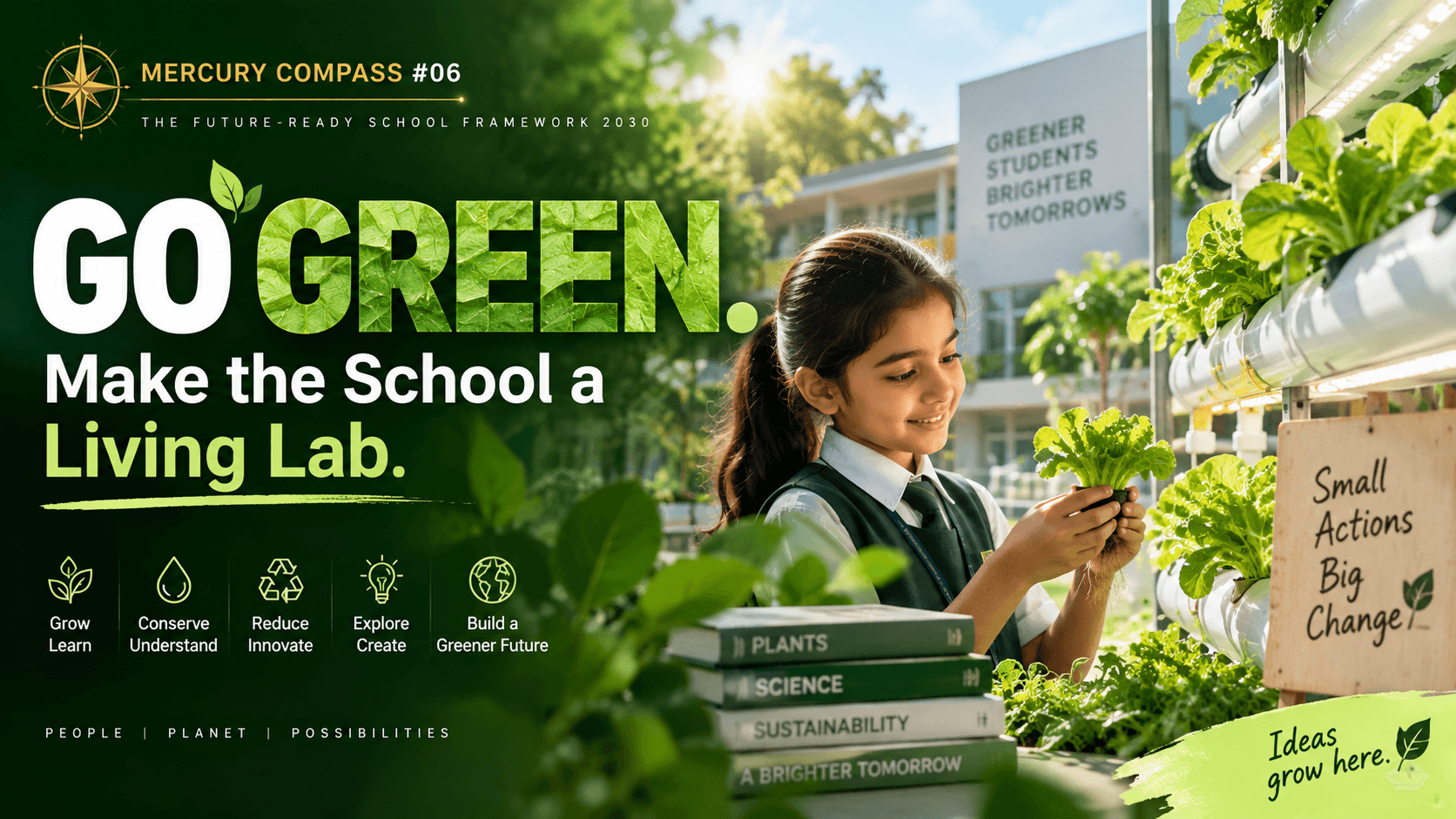
Go Green: Why Schools Should Become Living Laboratories
🧭 Mercury Compass #06
Students don’t just need to learn about a greener future. They need opportunities to experience how a greener future is built.
Introduction
Climate change, resource scarcity, biodiversity loss, food security and sustainable development are no longer distant global topics.
They are becoming part of everyday life.
Students are growing up in a world where questions about water, food, energy, waste and environmental responsibility are increasingly important.
Schools have an important role to play in preparing them for this reality.
But there is a fundamental question:
Are students only learning about sustainability—or are they experiencing it?
A lesson about plants can explain photosynthesis.
A textbook can describe the water cycle.
A chapter can discuss agriculture.
A classroom can explain renewable energy.
But what happens when students can actually grow a plant, monitor its development, measure water usage, investigate nutrients, analyse data and understand how an ecosystem responds to change?
The learning experience changes.
This is where the idea of the school as a living laboratory becomes powerful.
Beyond the Green Chapter in the Textbook
Environmental education is often introduced through subjects such as EVS, Science and Geography.
Students learn about:
- Plants
- Ecosystems
- Pollution
- Climate
- Natural resources
- Agriculture
- Conservation
These concepts are important.
But sustainability is not simply a body of knowledge.
It is a way of understanding how human decisions affect interconnected systems.
Students need opportunities to move from:
Learning about sustainability
to
Observing sustainability
to
Experimenting with sustainability
to
Designing sustainable solutions
This transition turns environmental education into experiential learning.
The school campus itself can become part of the curriculum.
What Is a Living Laboratory?
A living laboratory is an environment where real-world systems become opportunities for observation, experimentation, measurement and problem solving.
In a school, this could include:
🌱 A school garden
💧 A water conservation system
🌾 A hydroponic growing system
♻️ A waste management initiative
☀️ A solar energy installation
🐝 A biodiversity zone
🌿 A plant science learning space
📊 Environmental monitoring systems
Instead of treating these as decorative additions to a campus, schools can use them as learning infrastructure.
A plant is no longer simply something students see.
It becomes a scientific investigation.
Water is no longer simply something that comes from a tap.
It becomes a resource that students can measure, analyse and conserve.
Waste is no longer simply something that disappears into a bin.
It becomes an opportunity to understand consumption, decomposition, recycling and responsible resource use.
The campus becomes a classroom.
Why Green Education Needs to Become Experiential
Students remember concepts differently when they can connect them to direct experience.
Consider two learning experiences.
Classroom-only approach
A teacher explains how plants require:
- Water
- Light
- Nutrients
- Air
- Suitable temperature
Students take notes and answer questions.
Experiential approach
Students grow plants themselves.
They measure growth.
They compare different conditions.
They observe nutrient deficiencies.
They record data.
They investigate why one plant grows differently from another.
They adjust conditions.
They discuss their findings.
The scientific concepts remain the same.
But the learning process becomes active.
Students are no longer simply receiving information.
They are generating evidence.
Agriculture as a Learning Platform
Agriculture provides an unusually rich environment for interdisciplinary learning.
A single plant can connect multiple subjects.
Biology
Students investigate:
- Plant growth
- Photosynthesis
- Roots
- Nutrients
- Plant reproduction
- Ecosystems
Chemistry
Students can explore:
- Nutrient composition
- pH
- Mineral requirements
- Water quality
Physics
Students can investigate:
- Light
- Temperature
- Energy
- Water movement
Mathematics
Students can measure:
- Growth rates
- Water consumption
- Yield
- Temperature variations
- Environmental data
Technology
Students can explore:
- Sensors
- Automation
- Monitoring
- Data collection
- Digital dashboards
Entrepreneurship
Students can investigate:
- Food production
- Sustainable businesses
- Resource efficiency
- Market opportunities
One real-world system can therefore become a platform for multiple learning experiences.
Hydroponics: Rethinking How Students Learn About Agriculture
Hydroponics offers an interesting example.
Traditional agriculture generally depends on soil.
Hydroponic systems allow plants to be grown without conventional soil, using carefully managed water and nutrient systems.
For students, this creates a highly observable learning environment.
They can investigate questions such as:
How do plants grow without soil?
What nutrients do plants require?
How does water quality affect plant growth?
What happens when environmental conditions change?
How much water is actually required?
How can technology improve growing conditions?
These are not simply textbook questions.
They can become experiments.
Students can observe changes, record measurements, compare results and develop explanations.
That is where agriculture becomes STEM education in action.
From Observation to Experimentation
A green learning environment becomes much more valuable when students are encouraged to investigate rather than simply observe.
For example:
Observation
Students notice that two plants are growing at different rates.
↓
Question
Why are they growing differently?
↓
Hypothesis
Could light exposure or nutrient levels be influencing growth?
↓
Experiment
Students change one variable.
↓
Measurement
They record plant growth over time.
↓
Analysis
They compare the data.
↓
Conclusion
They explain what they discovered.
This is the scientific method operating within a real-world context.
Students develop scientific thinking without needing to treat every lesson as a theoretical exercise.
Technology Meets Sustainability
Green education does not have to mean going backward technologically.
In fact, technology can make sustainability more measurable.
Sensors can monitor:
- Temperature
- Humidity
- Moisture
- Light
- Water conditions
Digital systems can help students collect and visualise data.
Automation can demonstrate how technology can control environmental conditions.
AI can potentially support analysis, prediction and pattern recognition.
This creates an important connection:
Sustainability + Science + Technology + Data
Students begin to understand that solving environmental challenges is not simply about awareness.
It is also about measurement, experimentation, engineering and informed decision-making.
From Green Awareness to Green Action
There is an important difference between knowing that sustainability matters and being able to act on that knowledge.
A student may understand that water conservation is important.
But can the student:
- Measure water usage?
- Identify wastage?
- Analyse patterns?
- Propose a solution?
- Test the solution?
- Evaluate whether it worked?
That progression is important.
Awareness
“Water is important.”
↓
Understanding
“Water resources are limited.”
↓
Investigation
“Where is water being used?”
↓
Problem Solving
“How can we reduce unnecessary usage?”
↓
Action
“Let’s implement and measure a solution.”
This is the difference between learning about sustainability and learning through sustainability.
Life Cell: A Model for Experiential Green Learning
This is where dedicated plant science and hydroponics learning environments can create meaningful opportunities.
Life Cell is designed around the idea of bringing plant science, agriculture and environmental learning into a structured experiential environment.
Rather than treating plants as a topic confined to a textbook, a dedicated learning environment can allow students to explore:
- Plant growth
- Hydroponics
- Plant nutrition
- Water management
- Environmental conditions
- Sustainable agriculture
- Observation and experimentation
The value is not simply in having a hydroponic system inside a school.
The real value comes from what students do with it.
They can observe.
Measure.
Question.
Experiment.
Analyse.
Document.
Present.
Improve.
That transforms an installation into a learning platform.
What Students Actually Learn
A green learning environment can develop far more than environmental awareness.
Scientific Thinking
Students learn to observe, hypothesise, test and draw conclusions.
Data Literacy
Students collect measurements and use data to understand real-world changes.
Problem Solving
Students encounter problems where the solution is not immediately obvious.
Collaboration
Students work together to investigate and solve challenges.
Communication
Students explain findings and present evidence.
Sustainability Awareness
Students understand how resources and ecosystems are interconnected.
Entrepreneurship
Students can explore how sustainable technologies can create economic and social value.
Responsibility
Students experience the consequences of decisions involving living systems and natural resources.
This makes green education a powerful platform for developing future-ready competencies.
The School Campus as a Learning Ecosystem
A school does not have to build an entirely new campus to become more experiential.
Existing spaces can become learning environments.
A garden can become a biology laboratory.
A water system can become a conservation project.
A waste area can become a circular-economy investigation.
A solar installation can become an energy lesson.
A hydroponic system can become an agriculture and plant science laboratory.
A biodiversity area can become an ecology project.
The question is not always:
“What new infrastructure should we build?”
It can also be:
“How can we turn the infrastructure we already have into learning opportunities?”
That shift can significantly change how students experience their school environment.
What Does a Green School Really Look Like?
A green school is not defined simply by how many trees it has.
Nor is it defined by a single environmental campaign conducted once a year.
A genuinely green learning environment can connect:
Infrastructure
with
Curriculum
with
Student Participation
with
Measurement
with
Action
The goal is to create a culture where sustainability becomes something students experience regularly.
A Green School Readiness Checklist
School leaders can use a few simple questions to begin evaluating their current approach.
Curriculum
Are sustainability concepts connected to real-world experiences?
Campus
Can parts of the school campus function as learning environments?
Agriculture
Do students have opportunities to understand where food comes from?
Water
Can students observe or measure water usage and conservation?
Energy
Do students understand how energy is produced and consumed?
Waste
Do students participate in practical waste reduction or recycling initiatives?
Technology
Can students use sensors, data and digital tools to understand environmental systems?
Student Agency
Are students given opportunities to design and implement their own sustainability solutions?
Measurement
Does the school measure the impact of its sustainability initiatives?
These questions can help schools move from isolated activities toward a more integrated green education strategy.
Sustainability Is Not Just an Environmental Subject
One of the biggest opportunities for schools is to stop treating sustainability as a separate topic.
It can become a context for learning across disciplines.
A sustainability project can involve:
Science → understanding ecosystems
Mathematics → analysing data
Technology → monitoring systems
Engineering → designing solutions
Language → communicating findings
Social Science → understanding communities
Economics → studying resource use
Entrepreneurship → creating sustainable solutions
This is precisely where sustainability and STEAM education can intersect.
Students learn that real-world problems rarely belong to a single subject.
The Green School of 2030
By 2030, sustainability will continue to influence how communities think about food, water, energy, technology and economic development.
Schools have an opportunity to prepare students not merely to understand these challenges, but to participate in solving them.
Imagine a student who has:
- Grown plants using controlled systems
- Measured water usage
- Analysed environmental data
- Investigated biodiversity
- Designed a sustainable solution
- Presented the results
- Worked with a team
- Reflected on the impact
That student has experienced sustainability as something real.
Not simply a chapter.
Not simply a campaign.
Not simply a poster.
But a system that can be observed, measured, questioned and improved.
The Bigger Question for School Leaders
The question is not:
“Should our school go green?”
The more important question is:
“How can sustainability become part of how our students learn?”
Because the objective of green education should not be to create students who simply know that the planet needs protection.
It should be to develop students who understand systems, recognise problems, use evidence, design solutions and take responsibility for their decisions.
That is where environmental education becomes future-ready education.
Conclusion
The future of sustainability will require more than awareness.
It will require people who can understand complex systems, analyse evidence, use technology, collaborate across disciplines and design practical solutions.
Schools are uniquely positioned to begin developing these capabilities early.
The campus itself can become a laboratory.
Plants can become experiments.
Water can become data.
Waste can become a systems challenge.
Agriculture can become a STEAM project.
Technology can become a sustainability tool.
And students can become active participants in solving real-world problems.
The future-ready school does not simply teach students to go green.
It creates an environment where students can understand green systems, experiment with sustainable solutions, and experience the responsibility of building a better future.
Don’t just teach students about a greener future. Give them a place to build one.
Continue Reading
🧭 Mercury Compass #07
The Future-Ready Teacher: Why Teacher Development Is the Real Education Transformation
Technology, infrastructure and curriculum can change a school.
But meaningful transformation ultimately depends on the people who make learning happen.
The next edition explores the changing role of teachers and why continuous professional development is becoming a strategic priority for future-ready schools.
Coming Next Wednesday.
References & Further Reading
United Nations – Sustainable Development Goals
https://sdgs.un.org/goals
UNESCO – Education for Sustainable Development
https://www.unesco.org/en/education-sustainable-development
UNESCO – Greening Education Partnership
https://www.unesco.org/en/sustainable-development/education/greening-future
FAO – School Food and Agriculture Education
https://www.fao.org/school-food/
Ministry of Education, Government of India – NEP 2020
https://www.education.gov.in/nep
About Mercury Compass
Mercury Compass is Rapid Future Technology’s weekly thought leadership series for Principals, Correspondents, Trustees, Academic Leaders and Educators.
Published every Wednesday, Mercury Compass explores emerging technologies, education trends, leadership strategies, future skills and practical approaches that help schools navigate the changing landscape of education.
About Rapid Future Technology
Rapid Future Technology (RF Tech) partners with schools to build future-ready learning ecosystems through STEAM education, Robotics, Artificial Intelligence, Astronomy, Experiential Learning, Teacher Capacity Building and Educational Innovation.
Our focus is not simply on introducing technology into schools, but on helping institutions create meaningful learning experiences that develop curiosity, creativity, critical thinking, problem-solving and future-ready competencies.