

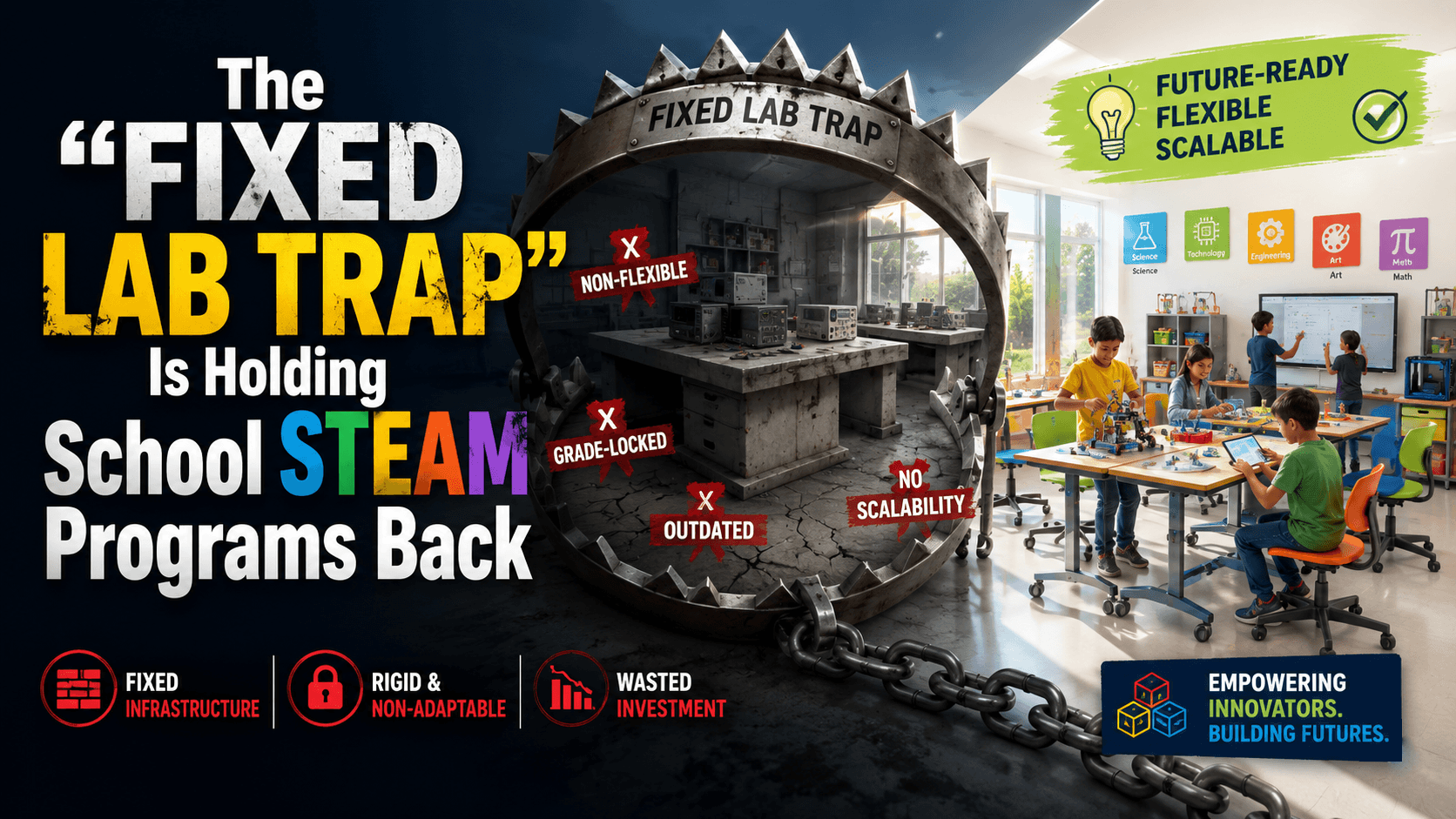
Difficult to choose customised STEAM program for your school?
Why Every School Should Think Beyond Traditional STEAM Lab Design
As schools embrace STEAM education, many invest in Robotics, Artificial Intelligence, Coding, 3D Printing, Electronics, and Makerspaces to prepare students for the future. However, one critical factor is often overlooked—the design and adaptability of the learning environment itself.
Many schools unknowingly fall into what we call the Fixed Lab Trap—a situation where a STEAM Lab is designed with permanent infrastructure, rigid layouts, and limited flexibility, making it difficult to adapt as technology, curriculum, and teaching methodologies evolve.
A future-ready STEAM Lab is not just about the equipment it contains. It is about creating a learning environment that evolves with your school, supports collaboration, and continues to deliver value for years to come.
What Is the Fixed Lab Trap?
The Fixed Lab Trap occurs when schools invest in a STEAM Lab that is difficult to modify, upgrade, or repurpose. While the lab may initially appear modern and well-equipped, fixed workstations, permanent furniture, and inflexible layouts can quickly become obstacles as educational needs change.
Schools often face challenges such as:
- Difficulty integrating new technologies
- High renovation and upgrade costs
- Limited flexibility for different teaching methods
- Poor utilization of available space
- Restricted collaboration among students
- Infrastructure that becomes outdated long before the equipment
Instead of enabling innovation, the learning environment begins to restrict it.
Why Does It Matter?
Education is evolving faster than ever. Technologies such as Artificial Intelligence, Robotics, Internet of Things (IoT), 3D Printing, Machine Learning, Electronics, and Design Thinking are becoming integral parts of classroom learning.
Teaching methods are also changing. Schools are increasingly adopting:
- Project-Based Learning (PBL)
- Inquiry-Based Learning
- Collaborative Learning
- Experiential Learning
- Design Thinking
- Interdisciplinary Learning
A learning space designed for yesterday’s classroom may struggle to support tomorrow’s educational needs.
A STEAM Lab Should Be More Than a Room Full of Equipment
One of the biggest misconceptions is that purchasing advanced robotics kits or computers automatically creates an effective STEAM Lab.
In reality, the most successful STEAM Labs combine technology, curriculum, teaching methodology, and learning environment.
Students learn best when they can:
- Explore ideas independently
- Work together in teams
- Prototype and test solutions
- Present their findings
- Learn from experimentation and failure
- Apply classroom concepts to real-world challenges
The physical learning environment should support these experiences rather than limit them.
Collaboration Is the Heart of Every Successful STEAM Lab
Technology is only one part of STEAM education. The real transformation happens when students collaborate, communicate, and solve problems together.
Collaborative learning enables students to develop skills that are increasingly valued in higher education and the modern workplace, including:
- Communication
- Teamwork
- Creativity
- Critical Thinking
- Leadership
- Problem Solving
- Adaptability
Unfortunately, fixed lab layouts can unintentionally discourage collaboration by limiting how students interact with one another.
A flexible STEAM Lab allows educators to rearrange learning spaces for group discussions, design challenges, coding workshops, robotics competitions, engineering projects, and interdisciplinary activities.
Instead of adapting teaching methods to the classroom layout, the classroom adapts to the learning experience.
Characteristics of a Future-Ready STEAM Lab

A modern STEAM Lab should be designed with long-term sustainability in mind.
Key characteristics include:
Flexible Infrastructure
Furniture and workstations that can be rearranged based on classroom activities.
Modular Design
Learning spaces that can grow as student strength and program requirements increase.
Multi-Grade Compatibility
A single learning environment that supports students across different age groups with age-appropriate activities.
Technology Integration
Support for Robotics, Artificial Intelligence, Coding, Electronics, IoT, Engineering, 3D Printing, and future technologies.
Collaborative Learning Spaces
Layouts that encourage teamwork, discussion, innovation, and project-based learning.
Curriculum Alignment
Programs that integrate seamlessly with CBSE, ICSE, State Board, Cambridge, IB, and other educational frameworks.
Fixed STEAM Labs vs Modular STEAM Labs
| Fixed STEAM Lab | Modular STEAM Lab |
|---|---|
| Permanent layouts | Flexible and adaptable layouts |
| Difficult to upgrade | Easy to expand and modernize |
| Limited collaboration | Encourages teamwork and innovation |
| High renovation costs | Lower long-term maintenance costs |
| Fixed learning environment | Dynamic learning environment |
| Limited scalability | Designed for future growth |
Questions Every School Should Ask Before Investing in a STEAM Lab
Before selecting a STEAM Lab solution, consider the following questions:
- Can the learning space be modified in the future?
- Will the infrastructure support emerging technologies?
- Does the design encourage collaborative learning?
- Can multiple grade levels use the same space effectively?
- Is the solution scalable as student enrollment grows?
- Will future upgrades require major renovation?
- Does the provider offer curriculum support and teacher training?
- Is there long-term technical support available?
Answering these questions before making an investment can help schools avoid unnecessary costs and maximize the educational value of their STEAM Lab.
Why Flexibility Creates Better Learning Experiences
Flexible learning spaces enable educators to adapt the classroom to different learning objectives.
A single STEAM Lab can be transformed into:
- A robotics programming zone
- A collaborative engineering workspace
- A coding classroom
- A makerspace for prototyping
- A design thinking workshop
- A science investigation area
- An innovation hub for interdisciplinary projects
This versatility allows schools to make better use of their infrastructure while creating richer learning experiences for students.
The RF Tech Approach
At Rapid Future Technology (RF Tech), we believe that a STEAM Lab should evolve alongside your students, teachers, and curriculum.
Our approach focuses on designing learning environments that are:
- Flexible
- Modular
- Future-ready
- Curriculum-aligned
- Scalable
- Collaborative
Our STEAM solutions support hands-on learning through Robotics, Artificial Intelligence, Coding, Electronics, IoT, 3D Printing, Design Thinking, and Engineering while encouraging creativity, innovation, and real-world problem-solving.
Rather than simply installing equipment, we help schools create sustainable learning ecosystems that can adapt to changing educational needs for years to come.
Frequently Asked Questions
What is the Fixed Lab Trap?
The Fixed Lab Trap refers to a STEAM Lab designed with rigid infrastructure that limits future upgrades, collaboration, and adaptability.
Why are modular STEAM Labs better?
Modular STEAM Labs offer greater flexibility, support collaborative learning, reduce renovation costs, and adapt more easily to evolving technologies and educational requirements.
Can one STEAM Lab support multiple grades?
Yes. A well-designed modular STEAM Lab can be configured to support students from primary through higher secondary using age-appropriate activities and resources.
Why is collaboration important in STEAM education?
Collaboration helps students build communication, teamwork, creativity, leadership, and problem-solving skills while working on real-world projects and design challenges.
How can schools future-proof their STEAM Labs?
Schools can future-proof their STEAM Labs by investing in flexible infrastructure, modular furniture, scalable technology, curriculum-aligned programs, and continuous teacher development.
Future-Proof Your STEAM Lab
A STEAM Lab is more than a classroom—it is a space where curiosity becomes innovation, ideas become solutions, and students develop the confidence to shape the future.
By choosing flexible infrastructure and a long-term approach to STEAM education, schools can create learning environments that remain relevant as technology and educational needs continue to evolve.
Don’t let today’s infrastructure become tomorrow’s limitation.
Partner with RF Tech
Whether you’re planning a new STEAM Lab, upgrading an existing facility, or exploring future-ready learning solutions, our team is ready to help you design a STEAM ecosystem that aligns with your school’s vision and long-term goals.
📞 +91 98405 55224
📞 +91 98400 60229
📧 info@rftech.in
Rapid Future Technology Pvt. Ltd.
Building Future Classrooms