

🧭 Mercury Compass #03
The Future-Ready School Framework 2030
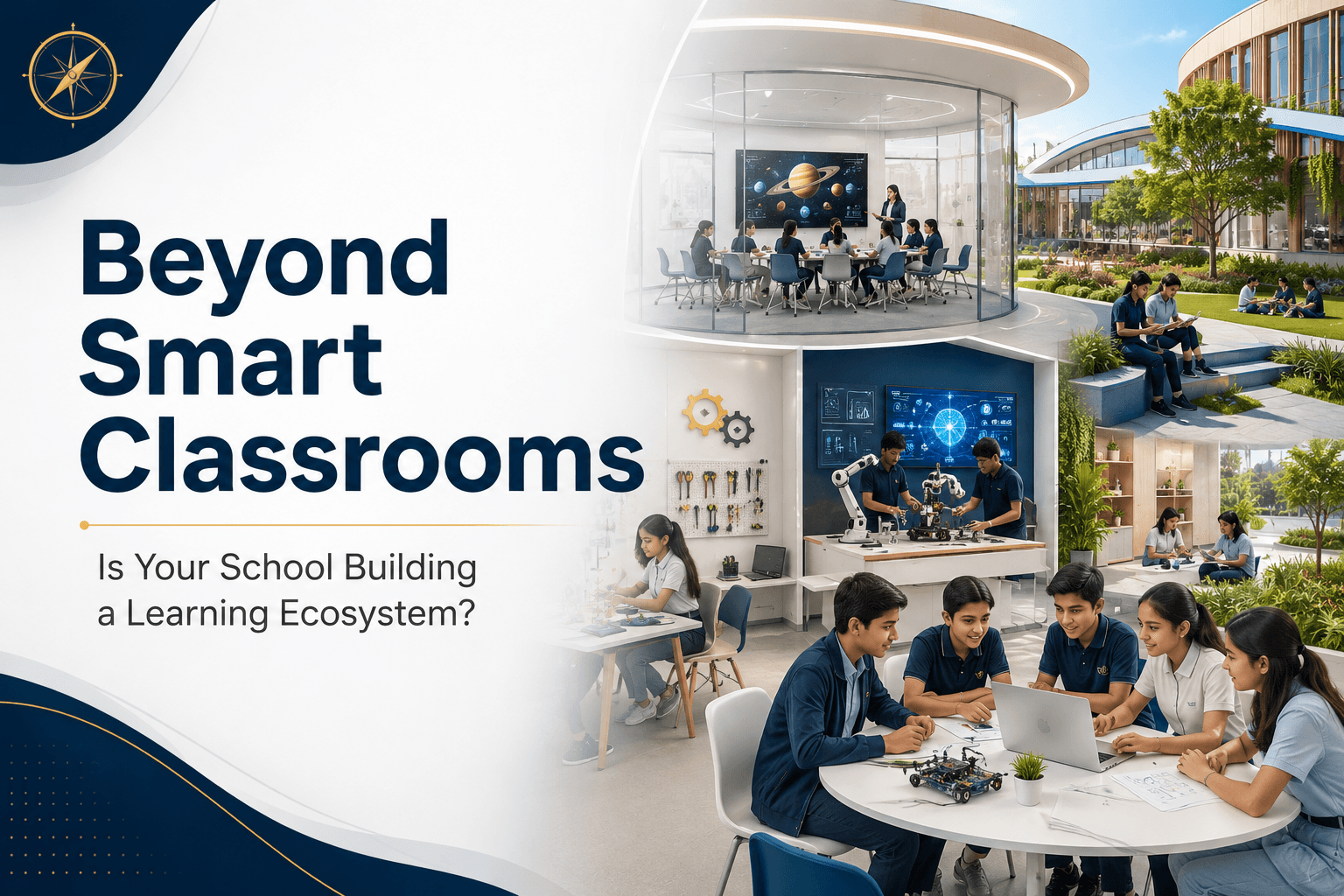
Chapter 3: Beyond Smart Classrooms – Building Complete Learning Ecosystems
Published by: Rapid Future Technology (RF Tech)
Series: Mercury Compass – Charting the Future of Education
Reading Time: 8–10 Minutes
Beyond Smart Classrooms: Building Complete Learning Ecosystems
Technology can modernize a classroom, but only a learning ecosystem can transform a school.
Introduction
Over the past decade, schools have invested significantly in digital infrastructure. Interactive panels, robotics kits, coding platforms, high-speed internet, and AI-powered learning tools have become increasingly common in K–12 education.
These investments represent important progress.
However, one critical question remains:
Why do some schools with advanced technology continue to struggle with meaningful educational transformation?
The answer is simple.
Technology is only one component of a much larger educational ecosystem.
A smart classroom can enhance teaching.
A learning ecosystem changes how students think, collaborate, create, and solve problems.
The schools that will lead education in 2030 will not be those with the most technology—they will be those that connect people, pedagogy, spaces, and purpose into a unified learning experience.
From Smart Classrooms to Smart Learning
Traditional classrooms were designed around delivering information.
Future-ready learning environments are designed around creating experiences.
Instead of asking:
- What technology should we purchase?
Leading schools ask:
- What experiences should students have?
- How can learning become more authentic?
- How can every space become a place for discovery?
- How do we prepare learners for problems that don’t yet exist?
Technology supports these goals—but it does not replace them.
What Is a Learning Ecosystem?
A learning ecosystem is an interconnected environment where students learn across classrooms, laboratories, makerspaces, outdoor environments, digital platforms, industry collaborations, and community experiences.
Knowledge is no longer confined to one room or one subject.
Students move seamlessly between exploration, experimentation, collaboration, reflection, and innovation.
Learning becomes continuous rather than compartmentalized.
The Five Elements of a Complete Learning Ecosystem
1. Purpose-Driven Learning
Every lesson should answer one question:
Why does this matter?
Students learn more effectively when knowledge is connected to real-world challenges, community issues, sustainability, entrepreneurship, and emerging careers.
Purpose creates motivation.
2. Flexible Learning Spaces
Future-ready schools create environments that adapt to different learning experiences.
Examples include:
- STEAM Labs
- Robotics Labs
- Innovation Hubs
- Makerspaces
- Astronomy Learning Spaces
- Outdoor Learning Areas
- Collaborative Discussion Zones
The learning environment itself becomes an active participant in education.
3. Integrated Technology
Technology should enhance—not dominate—the learning experience.
Meaningful integration includes:
- AI-assisted learning
- Digital collaboration
- Interactive simulations
- Data-informed teaching
- Virtual laboratories
- Creative design tools
Technology should encourage deeper thinking rather than simply delivering digital content.
4. Real-World Connections
Students develop lasting understanding when they engage with authentic experiences.
Schools can create these opportunities through:
- Industry interactions
- University partnerships
- Community projects
- Innovation challenges
- Student entrepreneurship
- Environmental initiatives
- Career exploration programs
Education becomes more relevant when learning extends beyond the campus.
5. A Culture of Curiosity
The most successful schools cultivate curiosity as a daily habit.
Students should feel encouraged to:
- Ask meaningful questions.
- Test new ideas.
- Learn from failure.
- Collaborate across disciplines.
- Reflect on their learning.
- Pursue lifelong growth.
Curiosity is the foundation of innovation.
Characteristics of Future Learning Ecosystems
A complete learning ecosystem encourages students to:
- Explore before memorizing.
- Collaborate before competing.
- Create before consuming.
- Solve before repeating.
- Reflect before moving forward.
These habits prepare learners not only for examinations but also for higher education, careers, and responsible citizenship.
A Reflection for School Leaders
Consider these questions:
- Does learning extend beyond traditional classrooms?
- Are students regularly solving real-world problems?
- Do teachers collaborate across subjects?
- Is technology supporting pedagogy rather than replacing it?
- Do learning spaces inspire creativity and innovation?
- Are students encouraged to ask questions as often as they answer them?
These reflections can help schools identify opportunities for meaningful transformation.
Looking Ahead
Building a learning ecosystem is not about adding more facilities.
It is about connecting every part of the school around a shared purpose: preparing students for a rapidly changing world.
When leadership, teachers, learning spaces, technology, and community partnerships work together, schools move beyond isolated initiatives and create environments where every learner can thrive.
The future of education will belong to institutions that design ecosystems—not just classrooms.
Coming Next Week
Mercury Compass #04
Artificial Intelligence in K–12 Education: Opportunity, Responsibility, and Readiness
How should schools embrace Artificial Intelligence while maintaining ethical, student-centered learning? The next edition explores practical strategies for integrating AI into teaching, learning, and school leadership.
References
About Mercury Compass
Mercury Compass is Rapid Future Technology’s weekly thought leadership series for Principals, Correspondents, Trustees, Academic Leaders, and Educators. Each edition delivers research-backed insights and practical strategies to help schools prepare for the future of education.
About Rapid Future Technology
Rapid Future Technology (RF Tech) partners with schools to create future-ready learning environments through STEAM education, Robotics, Artificial Intelligence, Astronomy, Experiential Learning, Teacher Capacity Building, and Educational Innovation, empowering institutions to build confident, capable, and future-ready learners.