

Published by
Rapid Future Technology (RF Tech)
Charting the Future of Education
Mercury Compass is RF Tech’s flagship weekly thought leadership series created for Principals, Correspondents, Trustees, Academic Leaders, and Educators.
Published every Wednesday, each edition explores emerging trends, educational research, leadership strategies, and innovative practices that help schools prepare for the future.
Whether you’re planning your next academic year or your vision for 2030, Mercury Compass is designed to provide practical insights that support informed decision-making.
Mercury Compass #1
Chapter 1: Why Schools Must Prepare for 2030
Estimated Reading Time: 8–10 Minutes
The Future Won’t Wait
Education has always evolved alongside society.
The Industrial Revolution shaped the factory-model classroom. The Information Age introduced computers and internet-enabled learning. Today, we stand at the beginning of another major shift—one driven by Artificial Intelligence, automation, climate science, biotechnology, and space exploration.
The pace of change is accelerating.
Technologies that once seemed futuristic are becoming part of everyday life. Artificial Intelligence is assisting doctors in diagnosis, supporting engineers in design, helping businesses make decisions, and changing how knowledge is created and accessed. At the same time, industries are placing greater value on creativity, collaboration, adaptability, and lifelong learning.
These changes raise an important question for every educational institution:
Are we preparing students for the world they will inherit, or the world we experienced?
This question lies at the heart of every future-ready school.
Education Is Entering a New Era
Across the world, education systems are being reimagined.
Organizations such as UNESCO, the OECD, and the World Economic Forum consistently emphasize that future learners need more than subject knowledge. They require transferable skills that allow them to adapt, innovate, and contribute throughout their lives.
Schools are therefore expected to become places where students do more than learn facts.
They should become places where students:
- Ask meaningful questions.
- Solve authentic problems.
- Work collaboratively.
- Design innovative solutions.
- Learn from experimentation.
- Develop confidence through experience.
This represents a shift from teaching information to developing capability.
Why Traditional Measures Are No Longer Enough
For generations, schools have been evaluated through board examination results, university admissions, and academic rankings.
These remain valuable indicators of educational quality.
However, they tell only part of the story.
Today’s parents increasingly ask different questions.
- Will my child become confident?
- Will they learn to communicate effectively?
- Can they think independently?
- Will they be prepared for careers that don’t yet exist?
- Will they become responsible global citizens?
Employers ask similar questions.
Universities increasingly evaluate portfolios, innovation projects, leadership experiences, and interdisciplinary learning alongside academic achievement.
The expectations placed upon schools have therefore expanded significantly.
The Skills That Will Define the Next Decade
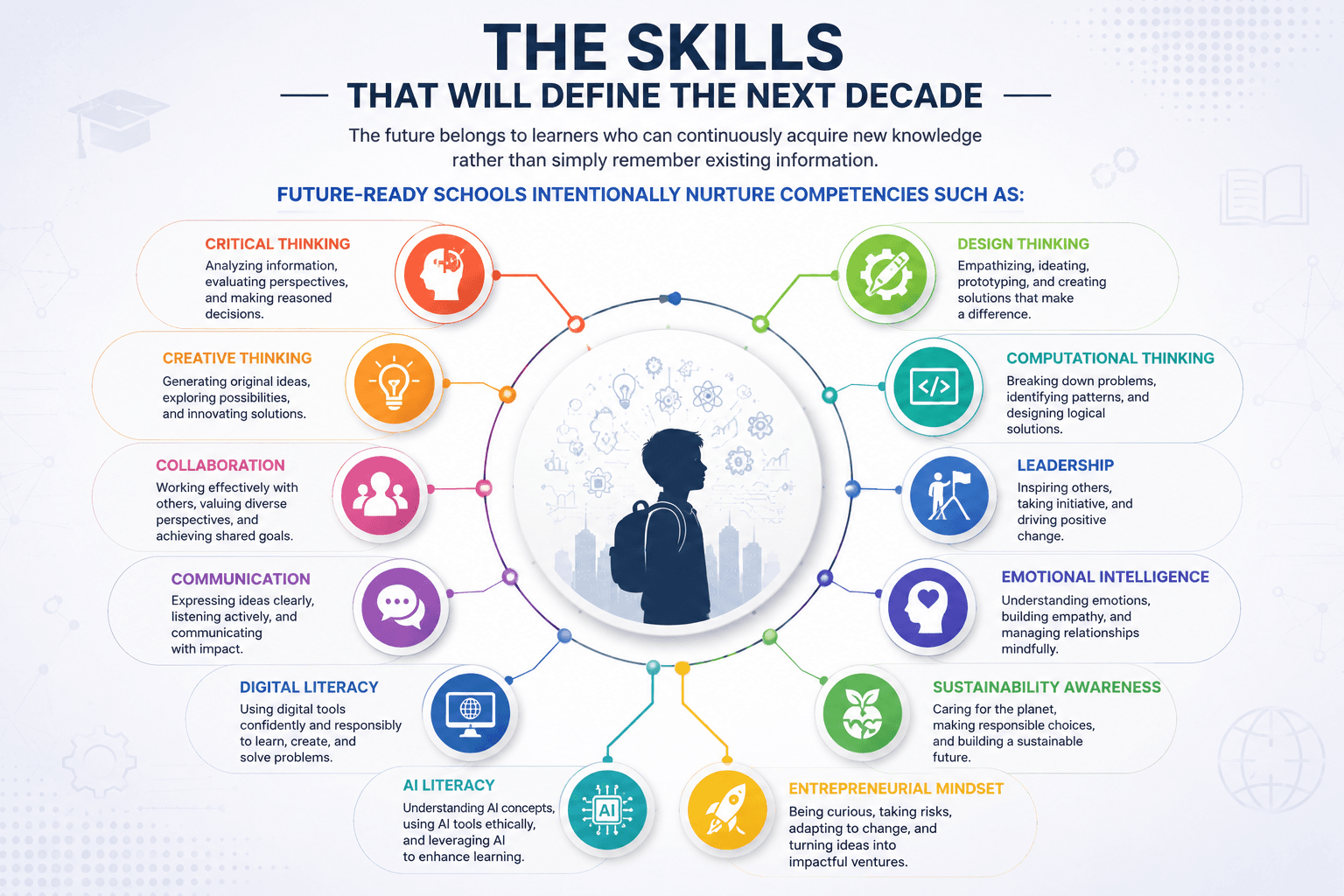
The future belongs to learners who can continuously acquire new knowledge rather than simply remember existing information.
Future-ready schools intentionally nurture competencies such as:
- Critical Thinking
- Creative Thinking
- Collaboration
- Communication
- Digital Literacy
- AI Literacy
- Design Thinking
- Computational Thinking
- Leadership
- Emotional Intelligence
- Sustainability Awareness
- Entrepreneurial Mindset
These competencies are not separate subjects.
They are ways of thinking that can be developed across every area of learning.
Beyond Technology
One of the biggest misconceptions about educational innovation is that becoming future-ready simply means purchasing new technology.
Technology is important.
But technology alone does not transform education.
A robotics lab without meaningful projects becomes another classroom.
An AI platform without trained teachers becomes another software subscription.
A makerspace without student ownership becomes another room on campus.
The schools leading educational transformation understand that technology is only effective when combined with:
- Visionary leadership
- Empowered teachers
- Authentic learning experiences
- Collaborative culture
- Continuous improvement
Infrastructure supports learning—but it never replaces it.
The Opportunity for School Leaders
Every significant educational transformation begins with leadership.
Future-ready schools are not created by chance.
They are intentionally designed.
Leadership teams establish long-term goals, invest in teacher capability, encourage innovation, and create environments where students are inspired to explore, question, and create.
The journey toward 2030 does not require schools to change everything overnight.
Instead, it begins by asking better questions.
- What kind of graduates do we want to develop?
- Which skills will matter most over the next decade?
- How should learning evolve to prepare students for an uncertain future?
- How can our school become a centre for innovation rather than simply instruction?
The answers to these questions become the foundation for long-term transformation.
Looking Ahead
Preparing for the future is not about predicting every technological advancement.
It is about creating schools capable of adapting to whatever the future brings.
Institutions that embrace curiosity, creativity, collaboration, and continuous learning will be better positioned to serve students, parents, and communities over the coming decade.
The future of education belongs not to the schools with the most technology, but to those with the clearest vision.
In Chapter 2, we’ll explore the Six Pillars of a Future-Ready School—the strategic foundations that enable schools to move from isolated initiatives to sustainable educational transformation.
Whether you’re beginning your innovation journey or expanding an existing one, these pillars provide a practical framework for building learning environments that prepare students for the opportunities and challenges of 2030.
➡ Next Chapter: The Six Pillars of a Future-Ready School
About RF Tech
Rapid Future Technology (RF Tech) partners with schools to build future-ready learning ecosystems through educational strategy, experiential learning, STEAM education, teacher development, robotics, sustainability, astronomy, and emerging technologies.
Through the Future-Ready School Framework 2030 series, we aim to share research-backed insights that help school leaders make informed decisions about the future of teaching and learning.
Coming Next Week
Chapter 2: The Six Pillars of a Future-Ready School
Discover the leadership principles, learning environments, and institutional practices that define schools prepared for the next decade of education.
Further References
- UNESCO – Education Futures: https://www.unesco.org/en/education
- OECD – Education 2030: https://www.oecd.org/en/topics/education-2030.html
- World Economic Forum – Future of Jobs Report: https://www.weforum.org/reports/the-future-of-jobs-report-2025/
- Ministry of Education, Government of India – National Education Policy 2020: https://www.education.gov.in/en/nep-new