

Technology has always played a major role in shaping human civilization. From the invention of the steam engine to the rise of computers and the internet, each technological breakthrough has transformed how societies function and how industries evolve.
Today, the world is entering another period of rapid transformation. Across laboratories, universities, and technology companies, researchers are developing innovations that could redefine how we live, work, communicate, and solve global challenges.
Many of these technologies are no longer theoretical ideas. They are actively being researched, tested, and implemented across different industries. As these innovations continue to advance, they will influence economies, infrastructure, education systems, healthcare, and everyday life.
This series explores the emerging technologies expected to shape the coming decades and the scientific ideas behind them.
A New Technological Revolution Is Emerging
Every major period in human history has been defined by technological revolutions.
The Industrial Revolution transformed manufacturing and transportation through steam engines and mechanization. The Electrical Revolution powered cities and industries through electricity. The Digital Revolution introduced computers, the internet, and global connectivity.
Today, we are witnessing the beginning of another technological shift.
Unlike previous revolutions driven by a single major invention, the current wave of innovation is powered by multiple technologies advancing simultaneously. Artificial intelligence, robotics, biotechnology, quantum computing, advanced materials, and space technologies are all developing at the same time.
These technologies are not isolated. They interact with one another and accelerate progress across many fields.
Artificial intelligence can help scientists analyze complex data. Advanced materials improve renewable energy systems. Space technology enables global communication and navigation.
Together, these developments are forming the foundation of the next technological era.
Why Emerging Technologies Matter
Emerging technologies will influence nearly every aspect of modern life.
They will change how industries operate, how healthcare systems function, and how cities manage infrastructure and transportation. Businesses are already integrating artificial intelligence into decision-making systems, while robotics is transforming manufacturing and logistics.
In healthcare, new technologies are helping doctors diagnose diseases earlier and develop more effective treatments. In energy systems, new battery technologies and renewable energy solutions are improving sustainability.
For students and young innovators, understanding these technologies provides valuable insight into the future of science, engineering, and global innovation.
The industries of tomorrow will rely on individuals who understand how technology works and how it can be applied to solve real-world challenges.
12 Technologies That Will Shape the Future
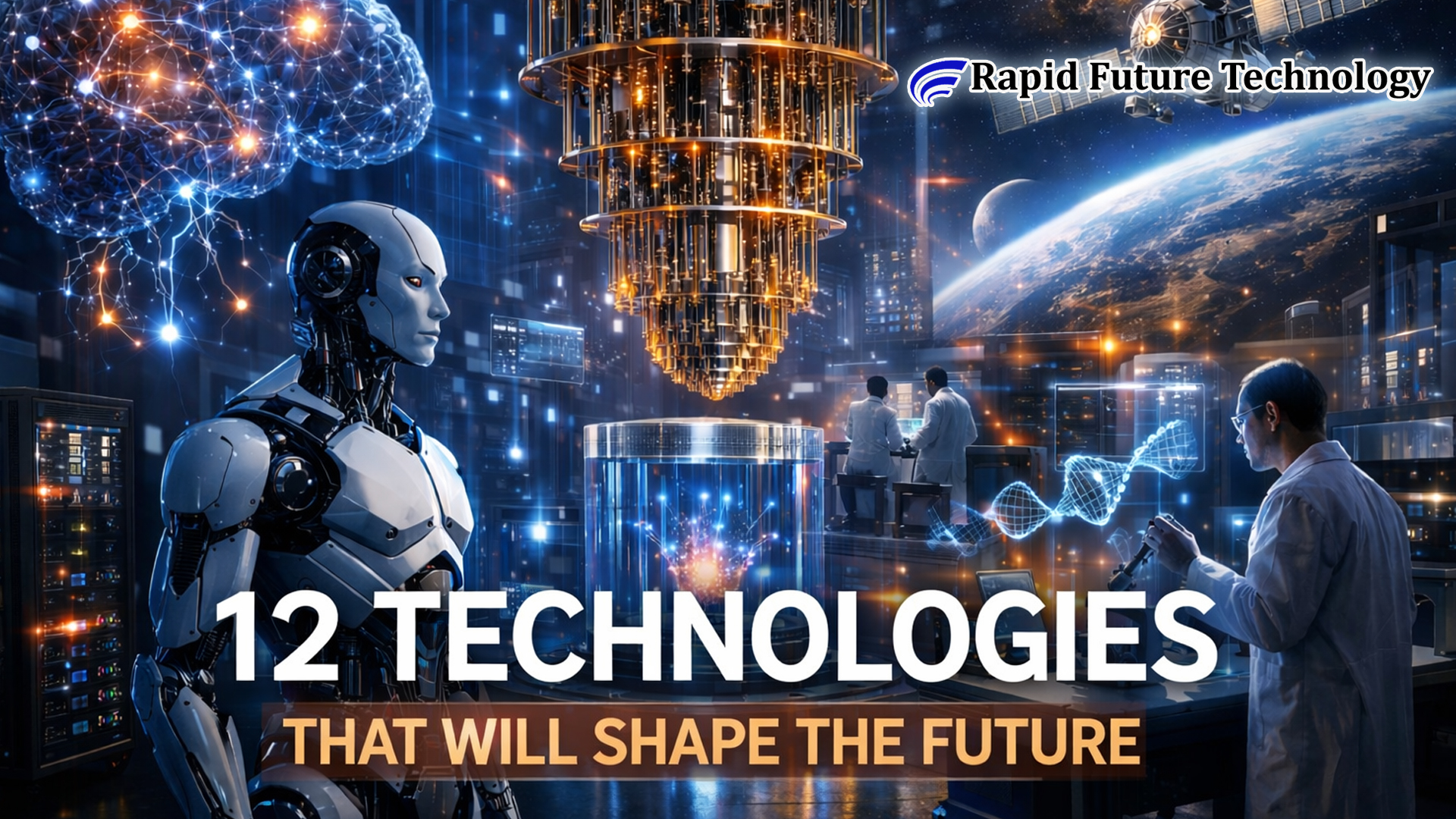
This series will explore twelve technological fields expected to have significant impact in the coming decades.
Artificial General Intelligence
Artificial intelligence today performs specific tasks such as recognizing images, translating languages, or analyzing data. Researchers are now exploring Artificial General Intelligence (AGI), a concept where machines could learn and reason across multiple domains similar to human intelligence.
Quantum Computing
Quantum computers use the principles of quantum mechanics to process information in ways that traditional computers cannot. This technology could solve extremely complex problems in fields such as medicine, materials science, and cryptography.
Brain-Computer Interfaces
Brain-computer interfaces aim to create direct communication between the human brain and digital systems. These technologies may help people control devices using neural signals and could transform healthcare and human-machine interaction.
Robotics and Physical AI
Robots are becoming more intelligent and capable of working alongside humans. Advanced robotics systems are being developed for industries such as manufacturing, logistics, healthcare, and disaster response.
The Space Economy
Space is becoming an important area of technological development. Satellite networks, reusable rockets, and space exploration technologies are expanding communication systems and enabling new commercial opportunities beyond Earth.
Fusion Energy
Fusion energy replicates the same process that powers the sun. If successfully developed, it could provide a nearly limitless and clean energy source for the future.
Climate Technology
Climate technologies are designed to address environmental challenges. These innovations include carbon capture systems, renewable energy solutions, and sustainable materials that reduce environmental impact.
Synthetic Biology
Synthetic biology combines biology and engineering to design and modify living organisms. Scientists are using this technology to produce medicines, develop sustainable materials, and improve food production.
Autonomous Transportation
Self-driving vehicles and automated logistics systems are transforming transportation. Autonomous technologies could improve safety, reduce traffic congestion, and increase efficiency in delivery systems.
Spatial Computing
Spatial computing blends digital environments with the physical world using technologies such as augmented reality and virtual reality. This technology could transform education, design, training, and collaboration.
AI-Driven Medicine
Artificial intelligence is rapidly transforming healthcare. AI systems are assisting doctors in diagnosing diseases, analyzing medical images, and accelerating drug discovery.
Advanced Materials
New materials such as graphene and advanced composites are enabling breakthroughs in electronics, aerospace engineering, and renewable energy technologies.
Why Understanding These Technologies Matters
The technologies explored in this series will shape industries, economies, and global innovation for decades to come.
They will create new career paths in science, engineering, computing, and research. They will also introduce new challenges that require thoughtful solutions and responsible innovation.
For students and educators, understanding these technologies helps connect scientific knowledge with real-world systems and applications.
When learners see how science and engineering contribute to solving global problems, education becomes more meaningful and inspiring.
What Comes Next in This Series
In the next article, we explore one of the most ambitious goals in modern computer science.
Artificial General Intelligence — When Machines Begin to Think
This topic examines how researchers are attempting to build machines capable of learning, reasoning, and solving problems beyond the limitations of today’s artificial intelligence systems.