

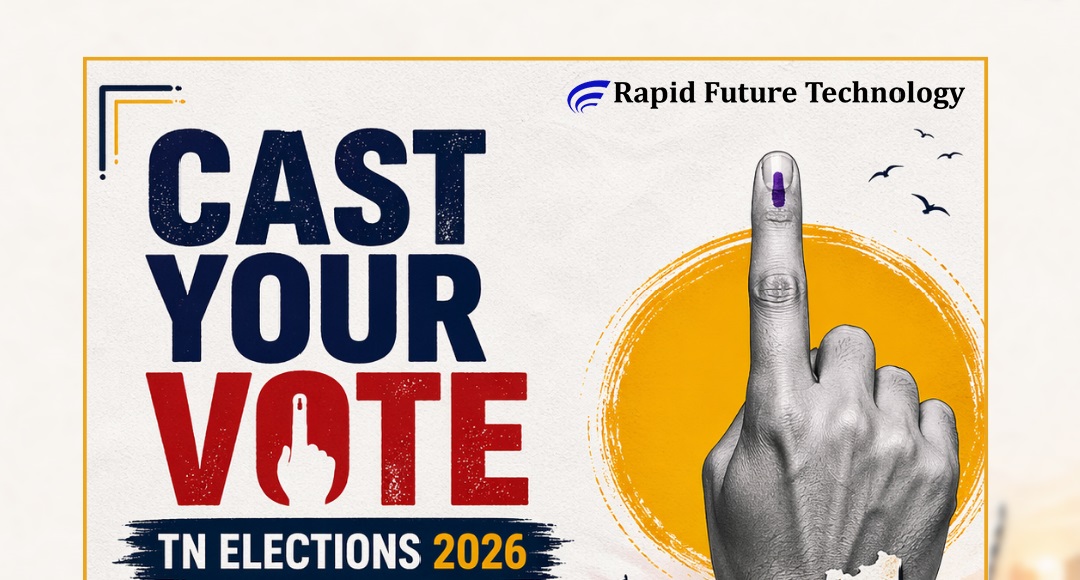
TN Elections 2026: Voter Awareness & Responsibility Guide
Tamil Nadu is preparing for the upcoming state elections scheduled on 23.04.2026, a crucial democratic process that will determine leadership and governance for the next five years. The elections will be conducted across all 234 constituencies of the Tamil Nadu Legislative Assembly, with each constituency electing one MLA. The process is administered by the Election Commission of India, ensuring a fair, transparent, and accessible voting system.
Your 5-minute decision shapes the next 5 years
Vote with common responsibility
🔍 How to check voter name in Tamil Nadu electoral roll
Before heading to vote, every citizen should verify their details in the electoral roll and confirm their polling booth location. You can easily check your voter details through the official National Voters’ Service Portal:
👉 NVSP Portal
Alternatively, you can use the Voter Helpline App provided by the Election Commission for quick access to:
- Voter ID status
- Polling booth location
- Electoral roll verification
Ensuring your name is listed correctly is the first step toward responsible participation.
🧾 Know Your Candidates details Tamil Nadu elections 2026
An informed vote begins with understanding who you are voting for. Every voter should review:
- Candidate background
- Party manifesto
- Past performance and credibility
You can explore candidate details and affidavits through the official Election Commission platforms:
👉 ECI Candidate Affidavit Portal
Evaluating promises against practicality helps voters make decisions that benefit society as a whole.
⚠️ Report Bribery or Election Violations
Accepting money or gifts in exchange for votes is illegal and undermines democracy. If you encounter such activities, you can report them through the official complaint platform:
👉 cVIGIL App
The cVIGIL app allows citizens to:
- Report bribery or misconduct
- Upload evidence (photo/video)
- Enable quick action by authorities
Maintaining integrity in elections is a shared responsibility.
✅ Voter Responsibility & Election Day Guidelines
Responsible voting involves preparation and discipline. Before and during election day:
- Verify your name in the electoral roll
- Carry a valid ID (EPIC / Aadhaar / Passport / Driving License)
- Confirm your polling booth location
- Follow polling officials’ instructions
- Check your vote carefully on the EVM and VVPAT
At the same time, avoid actions that compromise the process:
- Do not accept money or gifts for voting
- Do not vote under pressure or influence
- Do not disclose your vote
- Avoid spreading misinformation
⏰ Voting Time: 7:00 AM – 6:00 PM
📜 Tamil Nadu Election History
Tamil Nadu’s electoral landscape is one of the most studied in India for its high voter awareness, consistent turnout, and stable two-bloc competition. The state votes to elect members to the Tamil Nadu Legislative Assembly, which has 234 constituencies, and governments are formed by crossing the 118-seat majority mark. Elections are conducted every five years under the supervision of the Election Commission of India, ensuring a uniform, rules-based process across urban and rural regions alike.
The journey begins with the 1952 assembly election in the erstwhile Madras State, a period dominated by national parties—primarily the Indian National Congress. This early phase was shaped by post-independence priorities such as administrative consolidation, land reforms, and institution building. A decisive turning point came in 1967, widely recognized as the 1967 Tamil Nadu election, when regional politics, rooted in language, social justice, and state identity, moved to the center of governance. This election didn’t just change a government; it redefined the political vocabulary of the state, foregrounding welfare, inclusivity, and regional aspirations.
From the late 1970s onward, Tamil Nadu’s politics evolved into a structured bipolar contest, largely between the Dravida Munnetra Kazhagam (DMK) and the All India Anna Dravida Munnetra Kazhagam (AIADMK). This phase brought programmatic governance and competitive welfare—with successive governments expanding social schemes in education, nutrition, healthcare, and public distribution. The result has been a distinctive model where elections are often fought on delivery, credibility, and governance record, not just rhetoric.
Institutionally, the Assembly embeds inclusion through reserved representation—44 constituencies for Scheduled Castes (SC) and 2 for Scheduled Tribes (ST)—ensuring that policymaking reflects diverse communities. Over time, the Election Commission has also strengthened processes with Electoral Photo Identity Cards (EPIC), Electronic Voting Machines (EVMs), and VVPAT verification, improving both accessibility and auditability of votes.
Recent cycles underline how voter sentiment can decisively reshape leadership. The 2021 Tamil Nadu Legislative Assembly election saw a change in government after a decade, reflecting shifting public priorities and expectations. Equally important is the pattern of tight margins in multiple constituencies, where outcomes are often determined by small vote differences—reinforcing that individual participation aggregates into statewide outcomes.
What stands out across decades is the consistency of engagement: Tamil Nadu regularly records strong turnout across demographics, including urban voters, women, and first-time voters. Campaigns, manifestos, and public debates receive significant scrutiny, which in turn raises the quality of electoral choices. This ecosystem—historical continuity, competitive governance, and informed participation—explains why the state’s elections are seen as both predictable in structure and dynamic in outcomes.
Understanding this context is not academic—it is practical. In a system where 234 localized contests together determine state leadership, each constituency-level decision contributes to the larger mandate. That is why informed evaluation of manifestos, candidates, and track records matters—and why every vote carries measurable impact on governance, policy direction, and public services for the next five years.
As a team at Rapid Future Technology, we encourage every citizen to participate in the democratic process with awareness and responsibility.
Choosing the right leader is important—it shapes policies, opportunities, and the direction of our society. An informed vote is a powerful step toward meaningful progress.
As an organization committed to education, innovation, and empowering future generations, we believe responsible decision-making begins with awareness.
🗳️ Take part. Think clearly. Choose wisely.
🔚 Conclusion
Tamil Nadu’s electoral system shows that governance is shaped by collective participation. Every vote carries real impact, influencing policies, development, and opportunities for millions.